Teaching an autistic child in an elementary classroom can feel both deeply rewarding and a little intimidating, like being handed a super-powered gadget with no instruction manual. The good news is that you already have most of the tools you need. The trick is learning to use them a bit more intentionally.
See the student, not the label
Autistic students are as individual as any other children in your room. Some are talkative, some quiet. Some seek sensory input, while others feel overwhelmed easily. Thinking of them as “a student who happens to be autistic” rather than “the autistic student” keeps your focus on who they are, not just the diagnosis.
A little humor helps here. You might have a student who corrects you on dinosaur facts, insists the class hamster needs a “more robust enrichment protocol,” or notices every schedule change before you do. Those quirks can be reframed as strengths: attention to detail, honesty and wonderfully literal thinking.
Common challenges from a teacher’s perspective
For many elementary teachers, the toughest parts tend to fall into a few predictable categories:
- Sensory overload: Fire drills, loud transitions, fluorescent lights, or the sudden decision that now is the perfect time for an all-class sing-along.
- Unwritten classroom rules: Social expectations like “share,” “take turns,” or “don’t talk while the teacher’s talking” are not always obvious.
- Changes in routine: Assemblies, substitute teachers, testing schedules, or even moving a desk can feel like an unwanted plot twist.
- Peer misunderstandings: Classmates may see “different” behavior and respond with confusion, teasing, or exclusion.
When you recognize these as predictable friction points, you can plan for them instead of constantly reacting in the moment.
Support without putting a spotlight on them
One of the best ways to help an autistic child feel included is to build supports that benefit everyone and quietly support them. Think universal design for classroom life.
Routines and visual supports
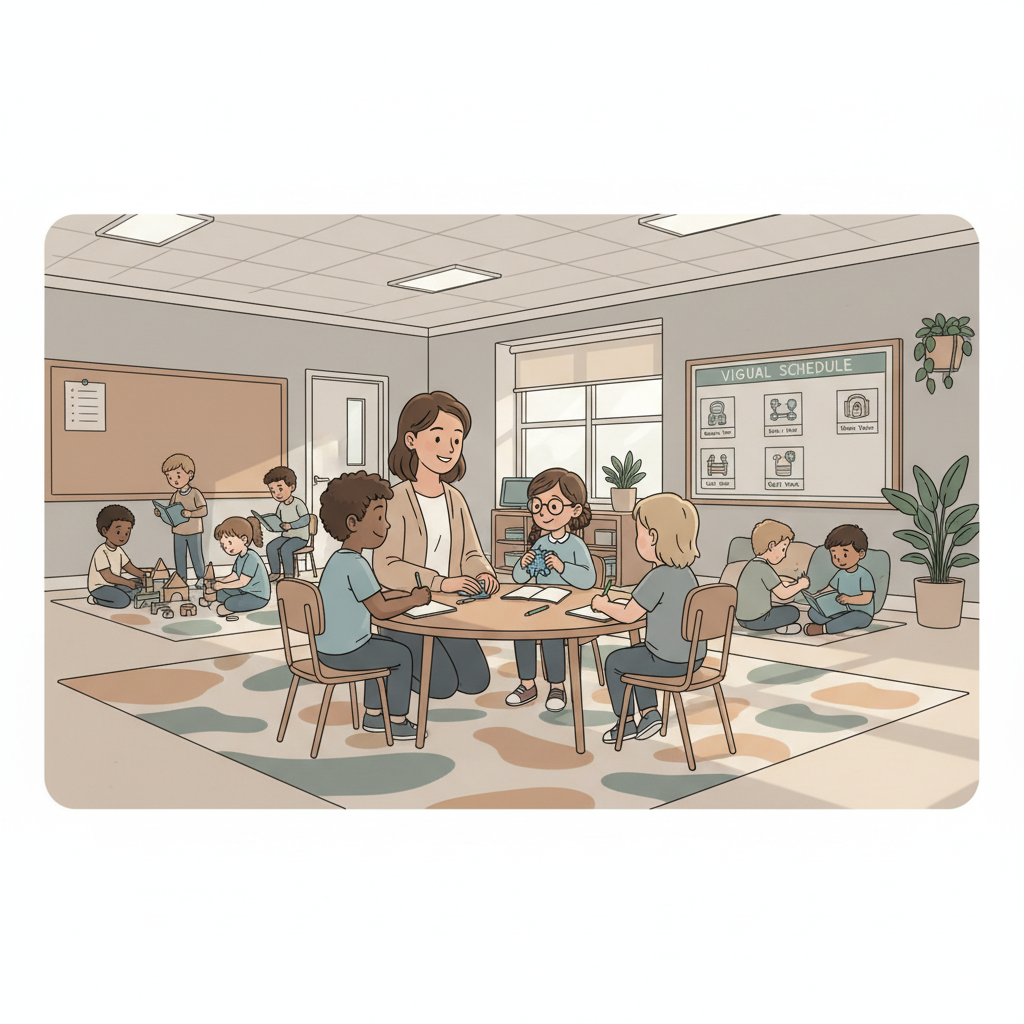
- Use whole-class visual schedules: Post a simple written or picture schedule so everyone knows what’s coming next. Your autistic student gets predictability, and your “I forgot my homework again” kid gets a helpful reminder.
- Preview changes for the whole class: Instead of pulling one child aside, try, “Heads-up, friends. Tomorrow we’ll have a fire drill around 10:00. It will be loud, but it’s just practice.”
- Pair verbal directions with visuals: Written instructions, step-by-step checklists or icons on the board help students who struggle to process spoken directions.
Flexible seating and sensory tools
Make sensory-friendly options feel like normal classroom choices, not special privileges.
- Offer a menu of seating options: Chairs, cushions, wobble stools, standing spots or clipboards for floor work. Present it as “choose a spot where you can do your best learning.”
- Normalize quiet fidgets: Keep a small basket of teacher-approved fidgets anyone can use, paired with a quick “Fidget Etiquette” talk: “Fidgets are for hands, not eyes or mouths.”
- Create a calm corner: Include timers, calming visuals and maybe headphones. Introduce it as a place any student can use to reset.
Because these supports are universal, your autistic student can use them without feeling singled out.
Supporting communication and social life
Social situations can feel like playing a board game where everyone else knows the rules but refuses to explain them. You can be the one who opens the rulebook.
Communication strategies that help
- Say exactly what you mean: Replace “Can we quiet down a bit?” with “Please stop talking and face the board.” Clear language removes guesswork.
- Allow processing time: Ask a question and pause. If needed, let the student know, “I’ll come back to you in a minute,” so there’s no pressure.
- Offer low-pressure choices: “Would you rather write your answer or tell it to me and I’ll write it?” preserves autonomy while supporting communication differences.
Encouraging social inclusion without forcing it
- Use structured group work: Clear roles like reader, writer or materials manager reduce anxiety and chaos.
- Teach kind curiosity: Model phrases like, “Everyone’s brain works differently,” or “If you’re not sure what someone likes, you can ask politely.” Students mirror your tone more than your posters.
- Pair by interest: If a student loves trains, space or a specific game, quietly connect them with peers who share that interest. Shared enthusiasm is powerful social glue.
A little humor helps here, too: “Some of us are rule followers, some are rule negotiators and some are rule re-interpreters. Our job is to live together without anyone taping anyone else to the wall.”
Preventing meltdowns and handling them when they happen
Meltdowns are not tantrums for attention. They’re usually a sign that sensory, emotional or cognitive overload has hit the limit. The goal is to keep the cup from overflowing whenever possible.
Proactive strategies
- Identify triggers: Notice patterns and, when appropriate, ask the student or caregivers what tends to cause distress. Build in supports like ear protection, extra warnings or clearer steps.
- Break tasks into chunks: “First… then…” language works wonders: “First finish these two problems, then you can choose a book.”
- Use quiet check-ins: Sticky notes, thumbs-up/sideways/down signals or a quick “How’s your brain doing?” can catch issues early.
In the moment
If a meltdown does occur:
- Lower demands: Focus on safety and calming the environment, not teaching a lesson.
- Say less: Short, calm phrases like “You’re safe,” “I’m here,” or “Let’s go to the calm corner” are more effective than long explanations.
- Debrief later: Talk about what was hard and what might help next time once everyone is calm.
If you’re thinking, “But I have 24 other kids,” that’s fair. The same routines and supports that prevent meltdowns often make the whole class run more smoothly. You’re not doing extra work. You’re doing smarter work.
Take care of yourself, too
Supporting an autistic child well doesn’t require being a perfect, endlessly patient superhero. It requires curiosity, flexibility and the willingness to adjust when something doesn’t work.
- Give yourself permission to experiment: Not every strategy will work for every student. That’s not failure, it’s information.
- Use your team: Special educators, school psychologists, paras and families are invaluable partners.
- Keep your sense of humor: You will misread situations, forget to warn the class about a schedule change, or say something that lands awkwardly. Your students will survive. So will you.