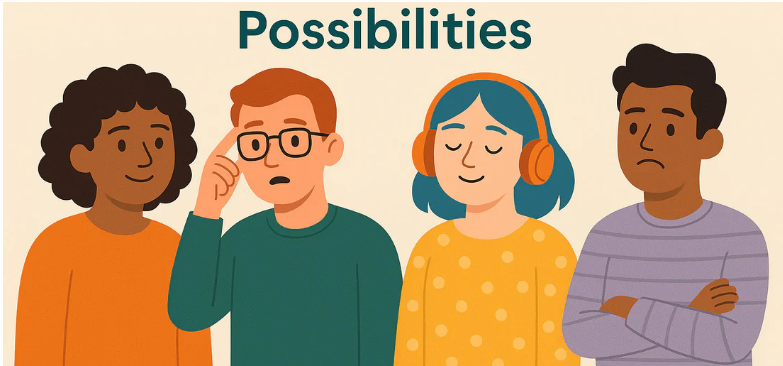
Let’s play a quick game: picture a person with ADHD.
Did you imagine someone bouncing off the walls like a cartoon character after a gallon of coffee? Or maybe a frazzled adult surrounded by half-finished projects and to-do lists written on the backs of receipts?
Now try picturing someone with autism.
Is it the classic “genius programmer who struggles with eye contact”? Or the adorable child lining up toys in perfect rainbow order?
Okay, now toss all those images in the recycling bin. Because here’s the thing: neurodivergence isn’t one-size-fits-all. In fact, it’s not even one-size-fits-some. It’s more like a giant thrift store of human experiences—every brain a little different, every story uniquely stitched together.
We’re Not Just the Stereotypes
Sure, some of us with ADHD are high-energy dynamos. Others? Masters of the Great Internal Stare, able to hyperfocus on a single topic for eight hours straight and forget to eat lunch (and maybe dinner, too).
Some autistic folks are verbal, some are nonverbal. Some are social butterflies who just wish people came with subtitles. Others prefer the company of cats, spreadsheets, or a good pair of noise-canceling headphones.
The neurodivergent umbrella covers a wide range of conditions: autism, ADHD, dyslexia, dyspraxia, OCD, Tourette’s and more. And within each of those labels? A kaleidoscope of traits, challenges, superpowers and everything in between.
Symptoms in Disguise
Symptoms can be subtle, strange, or show up wearing a hat and sunglasses pretending to be something else.
For example:
- Executive dysfunction might look like laziness (spoiler: it’s not).
- Sensory overload might seem like someone’s just being “dramatic” (they’re not).
- Repetitive behaviors might be soothing, not disruptive.
- Avoiding eye contact? It’s not a trust issue—it’s just… sometimes too much input!
And let’s not even start on masking. Or do—because masking (aka pretending to be “normal” to blend in) is exhausting. Many neurodivergent people become expert performers in the play called “Acting Neurotypical,” but it’s often draining and unsustainable. Spoiler alert: no one wins an Oscar for faking mental wellness.
Labels Aren’t Limitations
Getting a diagnosis (or even just suspecting you’re neurodivergent) can feel like flipping on the lights in a room you’ve been stumbling through your whole life. Suddenly, things start to make sense. That thing you beat yourself up for? Oh hey, it’s a symptom! That quirk you tried to hide? Turns out, it’s part of your wiring.
But remember: diagnoses are tools, not boxes. They’re not meant to limit who you are—they’re meant to help you understand yourself better and advocate for what you need.
Celebrate the Weird (and Wonderful)
Neurodivergence isn’t just about challenges. It’s also about the amazing, creative, curious, resilient, passionate, detail-obsessed, pattern-loving, world-changing people who fall under this delightfully colorful umbrella.
So whether you’re officially diagnosed, self-identified, or just exploring—you’re welcome here.
And if you’ve got a story, we’d love to hear it. How did you realize you were neurodivergent? What surprised you about your diagnosis? What myths do you wish people would stop repeating?
👇 Drop your experiences in the comments! Let’s make this a space full of shared laughter, “OMG, same!” moments and connection.
Because in the world of neurodivergence, there’s no “right” way to be. Just your way. And that’s more than enough.